
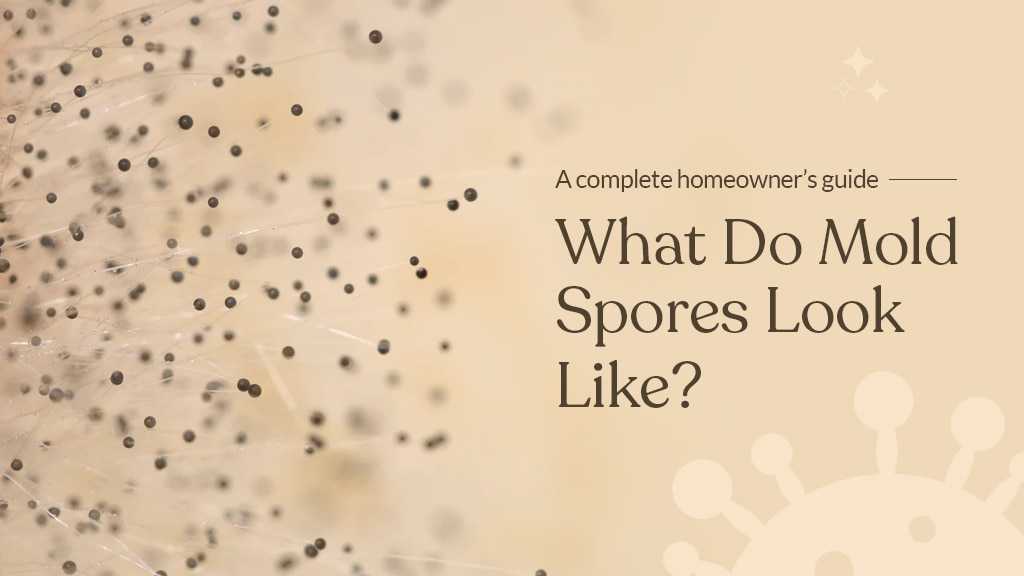
When people ask “what do mold spores look like,” the honest answer is simple: you usually can’t see them. Mold spores are microscopic particles that float in the air, but the signs they leave behind — stains, odors, and health symptoms — can be very visible. Understanding how spores behave is key to protecting your home, your air quality, and your health.
What Are Mold Spores?
Mold spores are tiny, airborne reproductive particles — essentially the “seeds” that fungi use to spread and colonize new surfaces. They’re a normal part of both indoor and outdoor air, and a certain background level is unavoidable in any home. The issue isn’t whether spores are present; it’s whether conditions let them take hold and multiply.
- Size: Typically 2–10 microns — for comparison, that’s roughly 5 to 25 times smaller than the width of a human hair, which is why they’re completely invisible to the naked eye.
- Spread: Spores travel easily through HVAC systems, open windows, clothing, and pet fur, which is how mold can appear in a room with no obvious moisture source of its own.
- Activation: A spore stays dormant until it lands somewhere with enough moisture and a food source (drywall paper, dust, wood, fabric) to germinate. Given the right humidity, that can happen in as little as 24–48 hours.
Moisture is the trigger. Without it, spores remain dormant indefinitely — which is why moisture control, not spore elimination, is the real goal of mold prevention.
What Do Mold Spores Look Like?
Individually, a mold spore can only be seen under a microscope — magnified hundreds of times, spores appear as small round, oval, or football-shaped particles, often in shades of black, green, or brown depending on species. In everyday life, though, what you actually notice is mold growth: the visible colony that forms after millions of spores settle and multiply in one spot.
Visible signs of mold growth:
- Fuzzy, powdery, or slimy patches
- Black, green, white, yellow, or orange coloring
- Circular or irregular spotting patterns that tend to spread outward over time
- A musty or earthy odor, often noticeable before any staining is visible
If you see or smell these signs, the spores in that area have already progressed well past the dormant stage into an active colony.
Common Types of Mold You Might See
Different mold species take on different appearances depending on the surface and moisture level involved:
- Black mold (often Stachybotrys chartarum): Dark, slimy-looking patches, usually linked to long-term, unaddressed moisture and considered one of the more concerning types to find indoors.
- Green mold (often Cladosporium or Aspergillus): Common on walls, insulation, fabric, and food; can appear more powdery than black mold.
- White mold: Powdery or thread-like, frequently found on wood, drywall paper, or in damp basements — easy to mistake for efflorescence (mineral salt deposits) on concrete.
- Yellow or orange mold: Typically grows on damp organic materials like wood or wallpaper paste, and can sometimes appear almost slimy or gelatinous.
Every one of these starts from the same kind of airborne spore — the differences in color and texture come down to species, surface material, and how much moisture has been available.
Hidden Mold: What You Might Be Missing
Mold doesn’t always grow in plain sight. In many homes, the most significant colonies are hiding in areas that are hard to access without opening up a wall or lifting flooring.
Signs of hidden mold:
- A persistent musty smell with no visible source
- Allergy-like symptoms at home — sneezing, coughing, eye or throat irritation — that ease up when you’re away
- Water damage or a past leak that was patched but never fully dried out
- Peeling paint, bubbling drywall, or warped baseboards and flooring
- Indoor humidity that consistently runs high, especially in bathrooms, kitchens, and basements
If you notice several of these signs together, spores may already be active behind walls, under flooring, or inside HVAC ductwork.
How to Detect Mold Spores in Your Home
DIY Methods (Limited Accuracy)
- Air test kits
- Surface swabs
- Visual inspection
These can flag that something’s off, but they can’t reliably identify the mold species, measure spore concentration, or trace the moisture source behind the growth — so a DIY result often raises more questions than it answers.
Professional Mold Testing
- Air sampling to measure spore concentration and identify species present in the air, even before any growth is visible.
- Moisture mapping, using thermal imaging and moisture meters, to find the hidden source feeding the mold — not just the mold itself.
- Lab analysis for accurate, documented identification, useful for treatment planning, insurance claims, or real estate transactions.
Professional testing gives clear, actionable results — and unlike a DIY kit, it tells you why the mold is there, not just that it exists.
Why Mold Spores Matter
Mold spores aren’t just harmless background particles. Once they establish a colony, they can:
- Affect indoor air quality throughout the home, not just in the room where growth is visible
- Trigger allergies and respiratory issues, particularly in children, older adults, and anyone with asthma
- Damage walls, ceilings, and other building materials over time
- Spread quickly to new areas as long as moisture persists
Early detection prevents a small, contained issue from becoming a larger and far more expensive one.
How to Prevent Mold Growth
Since spores are always present in the air, prevention isn’t about eliminating them — it’s about controlling the moisture they need to grow:
- Keep indoor humidity below 50%
- Fix leaks immediately, even small or slow ones
- Improve ventilation in bathrooms and kitchens, including running exhaust fans during and after showers or cooking
- Use dehumidifiers in naturally damp areas like basements and crawl spaces
- Inspect your home regularly, especially after storms, plumbing work, or any water intrusion
Stopping moisture stops mold — every prevention step ultimately comes back to that one principle.
Final Thoughts: Don’t Ignore the Signs
You may never see mold spores themselves, but you will see the effects if they start growing. Acting early can save you from costly repairs and ongoing health concerns.
At The Mold Inspection Canary, we provide detailed, unbiased mold inspections and testing throughout Los Angeles, Beverly Hills, Santa Monica, Malibu, Pacific Palisades, Pasadena, Glendale, Culver City, Manhattan Beach, Redondo Beach, Torrance, Venice, Marina del Rey, Sherman Oaks, Encino, Brentwood, Bel Air, Calabasas, Agoura Hills, Hidden Hills, Westwood, Century City, El Segundo, Hermosa Beach, Rancho Palos Verdes, South Pasadena, San Marino, Toluca Lake, and Westlake Village. If you suspect hidden mold or want clarity about your indoor air quality, scheduling a professional inspection is the safest next step.
FAQs
How can I tell if mold spores are in the air?
You should consider testing if you notice musty odors, allergy symptoms, or unexplained air quality issues. Mold spores are microscopic and cannot be seen directly, so air sampling is the most reliable way to detect their presence and identify concentration levels. Professional testing provides accurate results and real peace of mind.
Are mold spores harmful to health?
Mold spores can affect indoor air quality and trigger allergies, coughing, or respiratory irritation. Some individuals are more sensitive than others, especially those with asthma or a weakened immune system, and prolonged exposure may worsen symptoms over time. Testing helps determine the actual level of risk in your specific environment.
Can mold spores spread from room to room?
Mold spores spread easily through air, HVAC systems, and everyday movement, attaching to clothing, pets, and surfaces as they travel throughout the home. Once they find a spot with enough moisture, they begin growing in that new area. Early detection helps prevent contamination from spreading room to room.
Do all homes have mold spores?
Mold spores are naturally present in all indoor environments — there’s no such thing as a completely spore-free home. They only become a problem when moisture allows them to grow and multiply into visible colonies. Controlling humidity, fixing leaks promptly, and scheduling regular inspections all help keep spore levels in the normal, harmless range.
Can I remove mold spores myself?
You can clean small, visible mold spots on non-porous surfaces yourself, but spores in the air or in hidden spaces are difficult to control without proper equipment. DIY methods often fail to address the root cause — the underlying moisture issue — which means the mold is likely to return. A professional inspection identifies both visible and hidden mold sources for a complete, lasting solution.
