
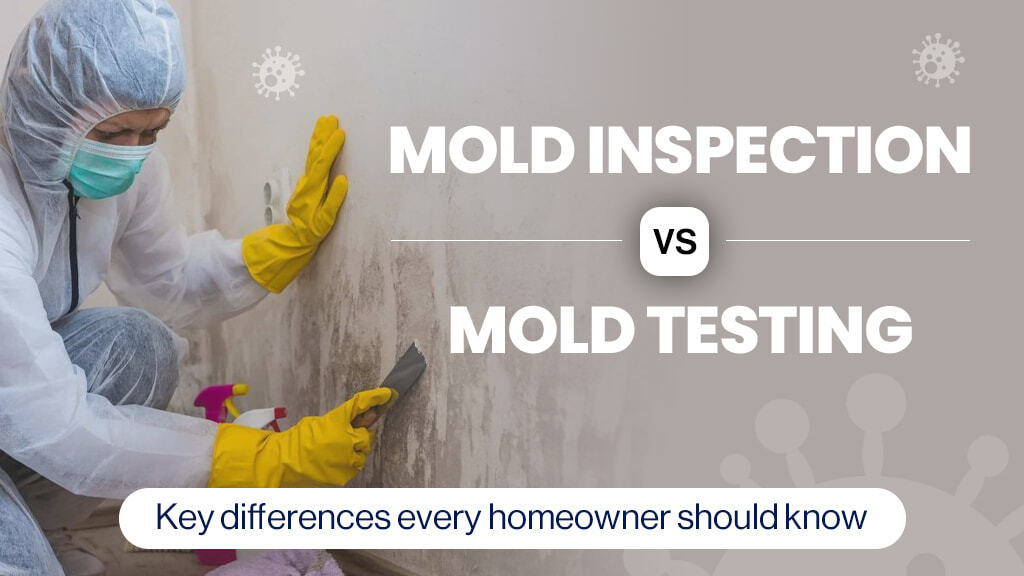
When dealing with potential mold issues, one of the most common questions is: do I need a mold inspection or mold testing? While these terms are often used interchangeably, they serve very different purposes.
Understanding the difference can save you time, money, and prevent unnecessary remediation.
What Is a Mold Inspection?
A mold inspection is a complete on-site evaluation of your property to identify signs of mold growth and, more importantly, the source of moisture causing it.
What a mold inspection includes:
- Visual assessment of all accessible areas
- Moisture mapping and humidity readings
- Thermal imaging to detect hidden moisture
- Identification of water intrusion sources
- Expert recommendations for next steps
The goal is not just to find mold, but to understand why it’s there and how to stop it. A good inspector is working to answer “what’s causing this” as much as “is mold present” — the second question without the first tends to lead to mold coming right back after cleanup.
What Is Mold Testing?
Mold testing involves collecting samples from the air or surfaces and sending them to a laboratory for analysis.
What mold testing provides:
- Type of mold present
- Spore concentration levels
- Indoor vs. outdoor air comparison
- Lab-certified results
Testing gives data, but it does not identify the full scope of the problem on its own — a lab report telling you what is in the air doesn’t tell you where it’s coming from or how far it has spread.
Mold Inspection vs. Testing: Key Differences
| Feature | Mold Inspection | Mold Testing |
|---|---|---|
| Purpose | Identify source & extent | Identify type & concentration |
| Method | Visual + tools (moisture meter, thermal camera) | Sample collection (air, surface, or both) |
| Output | Full report with recommendations | Lab results, typically returned in 24 hours–2 weeks |
| Detects moisture issues | Yes | No |
| Identifies mold species | No (visual assessment only) | Yes |
| Needed for every case | Often | Situational |
When Do You Need a Mold Inspection?
You should start with an inspection if:
- You notice a musty odor
- There is visible water damage
- You suspect hidden mold
- You are buying or selling a property
Inspection is the right first step in most cases, because it’s what tells you whether you actually have a mold problem worth pursuing further, and — critically — whether there’s an active moisture source that needs to be fixed regardless of what testing later shows.
When Is Mold Testing Necessary?
Testing is recommended when:
- Mold is suspected but not visible
- You need documentation for legal or insurance purposes
- Health concerns require identifying mold types
- Post-remediation verification is needed
Testing is best used as a supporting tool, not a replacement for inspection. Where testing tends to add the most value is in situations where a visual assessment alone can’t give you a confident answer — for example, confirming whether contamination has actually cleared after remediation, rather than just visually looking clean.
Why Inspection Without Testing Can Be Enough
In many cases, visible mold and moisture issues make testing unnecessary. If mold is clearly present on a small, accessible surface with an obvious moisture source, the priority is identifying and fixing that source — not spending money confirming what’s already visually apparent.
Testing becomes valuable when confirmation, documentation, or deeper analysis is required — situations where “it looks like mold” isn’t a strong enough basis for the decision you’re trying to make (a large remediation expense, a real estate negotiation, or a health concern for a vulnerable household member, for example).
The Biggest Mistake Homeowners Make
Many companies offer “free mold inspections” that are actually sales tactics for remediation services. This creates a conflict of interest, where the same company finds and fixes the problem — and has a financial incentive to find (or overstate) more than what’s actually there.
A true mold inspection should always be:
- Independent
- Unbiased
- Focused on accurate assessment, not selling services
If a company offering a “free” inspection can’t clearly explain how they make money without also selling you remediation, that’s worth asking about directly before scheduling.
Why Both Services Work Best Together
The most effective approach combines both: inspection identifies the problem and moisture source, while testing confirms the type and severity. Together, they provide a complete picture of your indoor environment — inspection without testing can miss what’s actually in the air, and testing without inspection can miss where it’s coming from and whether it will return.
How to Decide Which One You Need
If you’re still not sure where to start, a simple way to think about it:
- Start with inspection if you have any visible signs (odor, staining, visible growth) or a known past water event, regardless of whether you eventually need testing too.
- Add testing if the inspection can’t give you a confident answer on its own — hidden or suspected mold, documentation needs, health concerns, or verifying remediation actually worked.
- Skip straight to a combined assessment if you’re in a real estate transaction, dealing with a household member’s health concern, or need results that will hold up for insurance or legal purposes — in these cases, the extra cost of testing is usually worth the certainty it provides.
Final Thoughts: Make the Right Choice from the Start
Choosing between mold inspection and testing is not about picking one over the other. It is about understanding when each is needed.
At The Mold Inspection Canary, we specialize in inspection-only services with no remediation. We provide professional mold inspection services in Los Angeles, Santa Monica, Malibu, Beverly Hills, Manhattan Beach, Pasadena, and surrounding areas, ensuring completely unbiased results, accurate reporting, and no pressure to upsell unnecessary work.
If you are unsure whether you need inspection or testing, start with a professional assessment. The right approach early on can prevent costly mistakes later.
FAQs
What is the difference between mold inspection and mold testing?
A mold inspection identifies visible growth, moisture sources, and problem areas in your home. Mold testing collects samples to determine the type and concentration of mold spores. Inspection focuses on the cause, while testing provides lab-based confirmation. Both serve different but complementary purposes.
Do I need mold testing if I already see mold?
In most cases, testing is not required if mold is clearly visible on a small, accessible area. The priority is identifying the moisture source and addressing the issue. Testing is useful when documentation or mold type identification is needed, or when the visible mold is extensive enough to raise questions about hidden spread. A professional can guide you based on your specific situation.
Is mold inspection more important than testing?
Inspection is typically the first and most important step. It identifies where mold is growing and why it is happening. Without inspection, testing alone may not provide enough information to solve the problem, since a lab report can’t tell you where the moisture source is or whether it’s been resolved. Inspection guides the entire process, even in cases where testing is also warranted.
How much does mold inspection and testing cost?
Costs vary based on property size, number of samples, and complexity of the issue. Inspections usually have a base fee, while testing adds lab costs per sample collected. See our pricing page for current rates, or contact us for a quote specific to your property. Transparent, itemized pricing is worth prioritizing to avoid surprises.
Can I do mold testing myself?
DIY mold test kits can detect spores but are often limited in accuracy and interpretation — most can’t reliably distinguish species or provide a meaningful outdoor comparison baseline. They also don’t identify moisture sources or hidden mold problems, which is arguably the more important piece of information. Professional testing provides reliable lab results and expert analysis; for anything beyond idle curiosity, professional assessment is the more reliable path.
